|
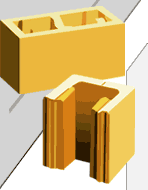
The patented EuroAm
(Haener® Interlocking & Mortarless Concrete) Block System
comprises interlocking blocks that "dry stack" (i.e.
require no mortar) making it similar to a child's LEGO set.
Plumbing and electrical conduits are placed in existing recesses
within the wall so there is no chasing into the block and
subsequent plastering. Holes are drilled with precision at the
exact location an electrical or plumbing fixture is required.
Therefore, if any electrical or plumbing changes are desired in
the future, changes can be made easily as the exact location of
the existing pipes or conduits is known.
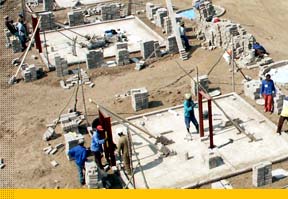
With
minimal training, unskilled labour can master the application of
the EuroAm Block System very quickly. The EuroAm Block System can
be laid up to five times faster than conventional blocks can be
laid. As the blocks interlock, the walls will always be square and
level as the unique tongue and groove design requires a tight fit
before the next block is laid.
In
addition, the EuroAm Block System far exceeds the strength of
conventional block and mortar construction. The reason for this is
that mortar has a maximum strength of 2-3 MPA, therefore the
strength of a common block and mortar wall will theoretically not
exceed this figure. (Note: In the case of an earthquake, it is
generally the mortar that breaks, not the concrete block.) On the
other hand, the strength of the EuroAm BlockSystem is at least 17
MPA and because the blocks interlock (i.e. no mortar used), the
strength of this wall far exceeds one constructed with
conventional materials.
Being
a hollow core block the thermal and acoustic insulation is
excellent. Furthermore, the solid construction technique satisfies
the end-user's demand for a solid house built from
"traditionally accepted" materials.
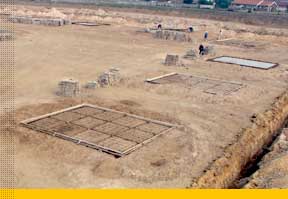
Columns
are poured where needed. Concrete is poured around the window and
door openings from within the wall using rebar in conjunction with
inserts to prevent the concrete from spreading throughout the
wall. The tie beam is poured by placing corner blocks upside down,
thus eliminating the expense and downtime of carpentry to form the
beam.
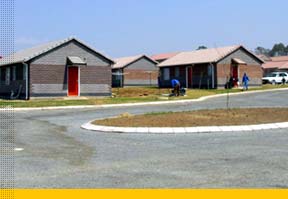
EuroAm
designers and architects have guarded against the possibility of a
"concrete barrack" development. The nature of the
patented moulds facilitates the possibility of different colours
and patterns on the various blocks.The roof tiles are also
available in different colours. In addition, EuroAm's architects
have designed a number of different elevations to distinguish each
house.
The
mechanical process uses proven hydraulics, thus eliminating the
need for highly skilled personnel to operate the block production
machinery. The rate of production is four blocks per drop, at
seven drops per minute, or 1 680 blocks per hour. Working two 8-hour shifts 26 880 blocks can
be produced per day, which equals 22 houses @ 42 square metres.
Making allowances for breakdowns, inclement weather etc. one block
making machine can easily provide enough blocks to build 5 000
houses per year.
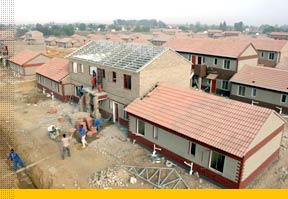
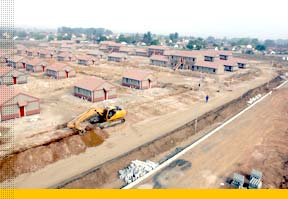
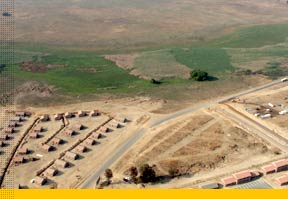
The
production capacity and the fact that lightly supervised unskilled
labour can build a house in one day, makes this system one of the
most viable solutions to the current housing crisis in Africa.
|